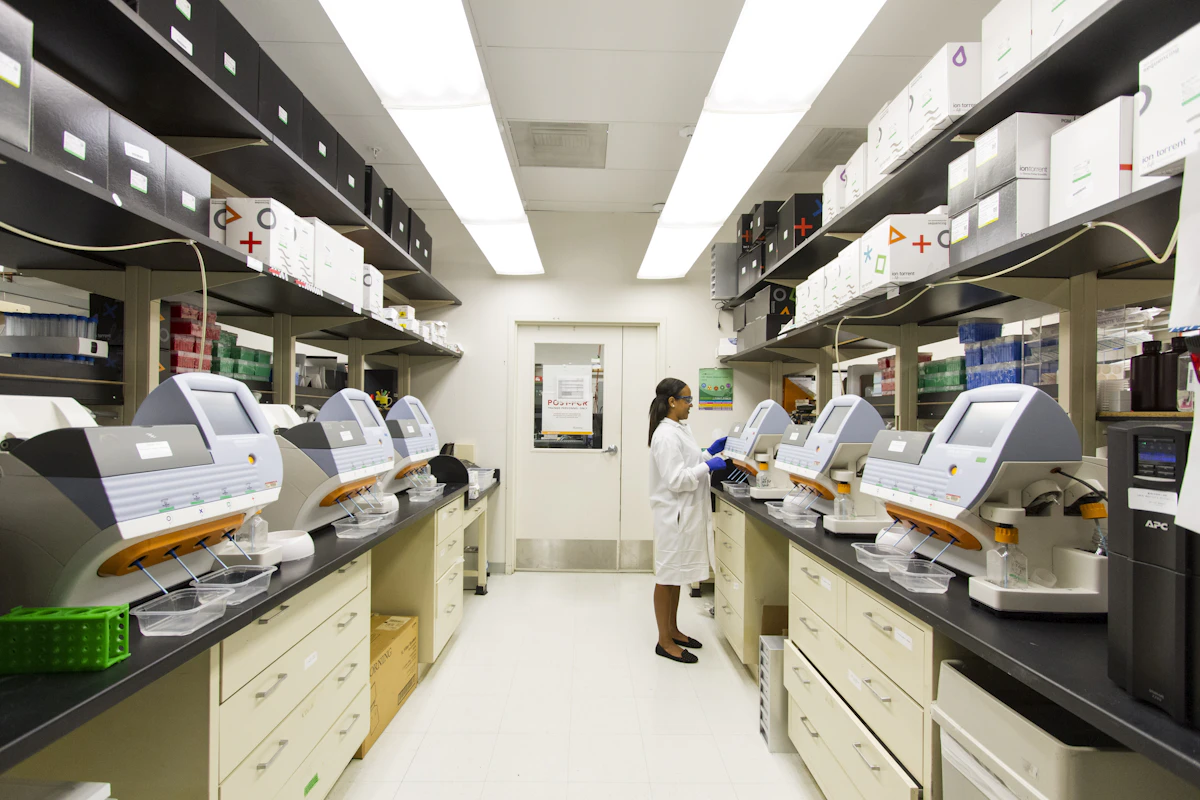
Deep-science founders face a brutal equation: world-class lab equipment costs crores, and most investors won't fund science they can't touch. C-CAMP - the Centre for Cellular and Molecular Platforms in Bengaluru - was built to break that equation. Supported by the Department of Biotechnology, Government of India since 2009 and anchored in the Bangalore Life Science Cluster (BLiSC) alongside NCBS and inStem, it gives bio-founders million-rupee technology platforms, seed funding schemes and mentorship - without the capital outlay.
Mission
C-CAMP describes its mission as enabling "high-end scientific research and fostering deep science innovations for societal impact". Unusually for an incubator, it is designed and helmed by scientists, and is explicitly attuned to scientist-entrepreneurs. Incubation activity began in 2012. Its sectors span healthcare, med-tech, agri-biotech, industrial biotech, biopharma, medical devices, diagnostics, digital health and AI, synthetic biotechnology, environmental biotech and FMCG, from ideation to scale-up.
Funds, stages and cheque sizes
C-CAMP itself discloses no internal fund size. But the capital routes through it are substantial and public. It is a founding partner of DBT/BIRAC's Biotechnology Ignition Grant (BIG): grant-in-aid of up to Rs 50 lakh over 18 months, milestone-based, for ideation to proof-of-concept. NITI Aayog's Atal Innovation Mission gave its bio-incubator Rs 10 crore over two years in 2017. Its 2026 climate cohort offers up to Rs 50 lakh per startup. And per Deccan Herald (September 2026), C-CAMP plans to raise Rs 400 crore by 2028 for its Innovation Park - a plan, not a secured corpus. Scale today: CEO Taslimarif Saiyed says C-CAMP currently supports 700+ deep-science and life-science startups, aiming to triple that with the park. Earlier, ET reported seven C-CAMP deeptech startups had raised more than Rs 550 crore (over $70 million) in a single quarter.
Notable graduates
The marquee names: Bugworks, Sea6 Energy, String Bio, Eyestem, Pandorum, Achira and Zumutor, plus Theramyt, Coeo and Module. The October 2026 climate cohort added Genepath Diagnostics India, Intello Labs, Ossus Biorenewables, Earthkind Foods Biotech and Bisket Labs.
People
Dr Taslimarif Saiyed is CEO & Director - a neuroscience PhD from the Max Planck Institute with a UC Berkeley/UCSF biotech-management background. S. Ramaswamy was an earlier CEO (now at inStem), and Nandita Chandavarkar has coordinated the accelerator programme.
Credits and perks
This is where C-CAMP is genuinely unmatched: around 59,000 sq ft of incubation space; platform technologies including confocal and fluorescence microscopy, flow cytometry and sorting, and high-resolution analytical and mass spectrometry via an expanded Agilent partnership - so startups get advanced workflows without direct capital investment. Add market and research consulting, due diligence, IP analysis, technology transfer and regulatory-affairs support. The planned C-CAMP Innovation Park (operational 2028) is a 5-acre, 5,00,000 sq ft campus with 100+ laboratories and capacity for 2,000+ scientists.
How to engage
Entry runs through public calls on ccamp.res.in: the BIG grant (twice-yearly via BIRAC's BIG partners), the National Bio Entrepreneurship Competition (NBEC) - described as India's largest ideas platform - accelerator cohort calls, and thematic calls like the climate-solutions round. The I-SEP equity partnership offers up to Rs 30 lakh post-POC. Contact: [email protected], +91 80 67185100.
Why it matters for founders
For life-sciences founders, C-CAMP is not just an incubator - it is the only place in India where a two-person team can run confocal microscopy, mass spec and flow cytometry without buying any of it. If your innovation is deep science, this is the single highest-leverage application you can file.